> For the complete documentation index, see [llms.txt](https://docs.raga.ai/llms.txt). Markdown versions of documentation pages are available by appending `.md` to page URLs; this page is available as [Markdown](https://docs.raga.ai/ragaai-catalyst/concepts/embeddings.md).
# Embeddings
Explore how RagaAI Catalyst uses vector embeddings for semantic analysis. Visualize spaces, compare query–document similarity, and apply metrics to evaluate LLM retrieval quality.
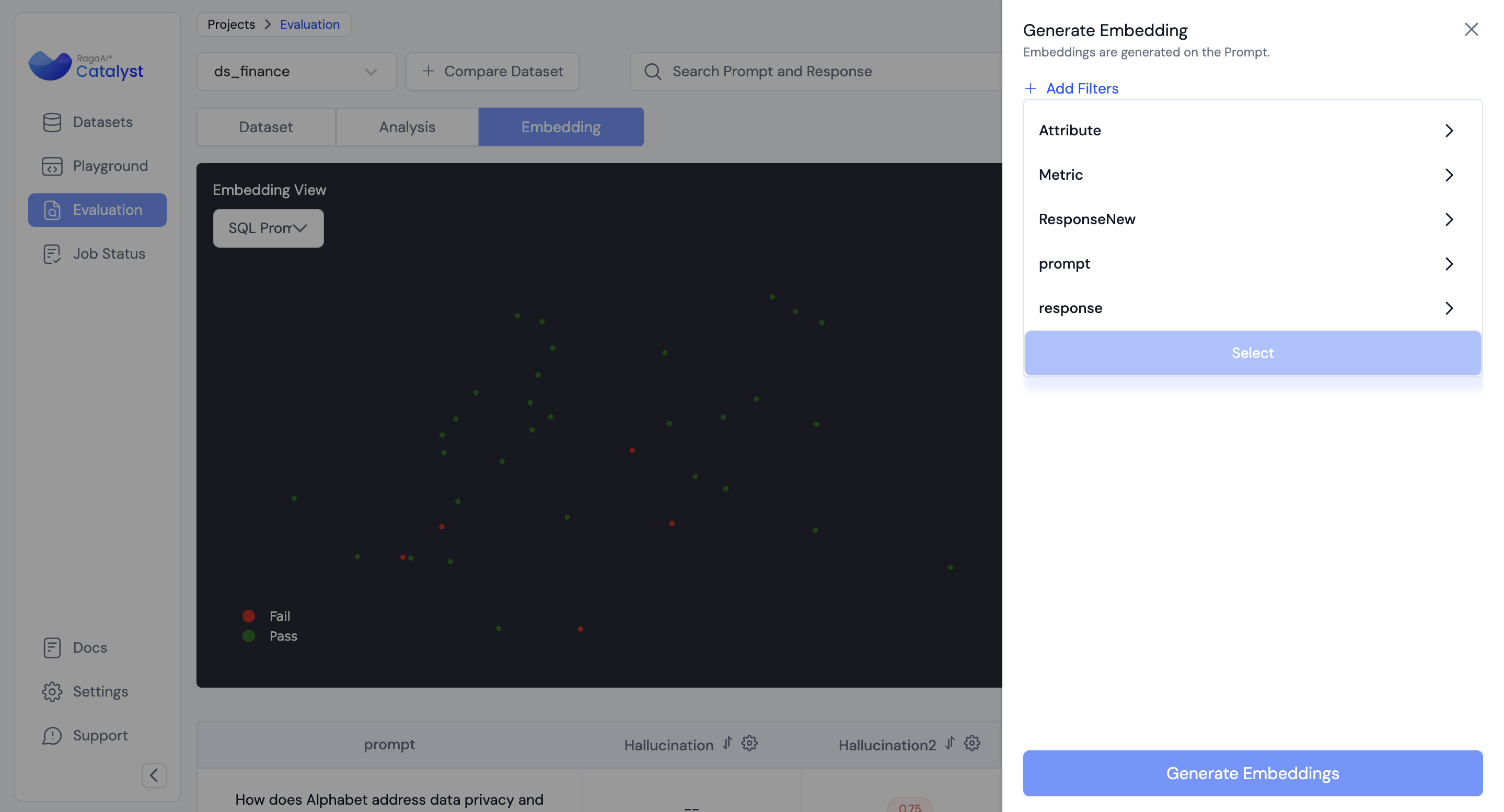
The **Generate Embeddings** feature allows users to create embeddings for their dataset based on prompts. .
The **Analysis** tab is located within the following path:\
**\[Project > Dataset > Evaluation > Embeddings]**
### How to Generate Embeddings
#### 1. Initiating the Embedding Generation
* To start generating embeddings, click on the **"Generate Embeddings"** button.
* **Note**: Embeddings are generated on the basis of Prompt Column.
#### 2. Applying Filters (Optional)
* If you only want to generate embeddings for specific data points, you can apply filters. These filters help you narrow down the data points to focus on specific criteria before generating embeddings.
* For example, you may choose to apply filters based on metadata or response columns.
#### 3. Generating Embeddings
* Once you’ve set your filters (if any), click **"Generate Embeddings"** to create a job.
generate embeddings
#### 4. Viewing the Embeddings
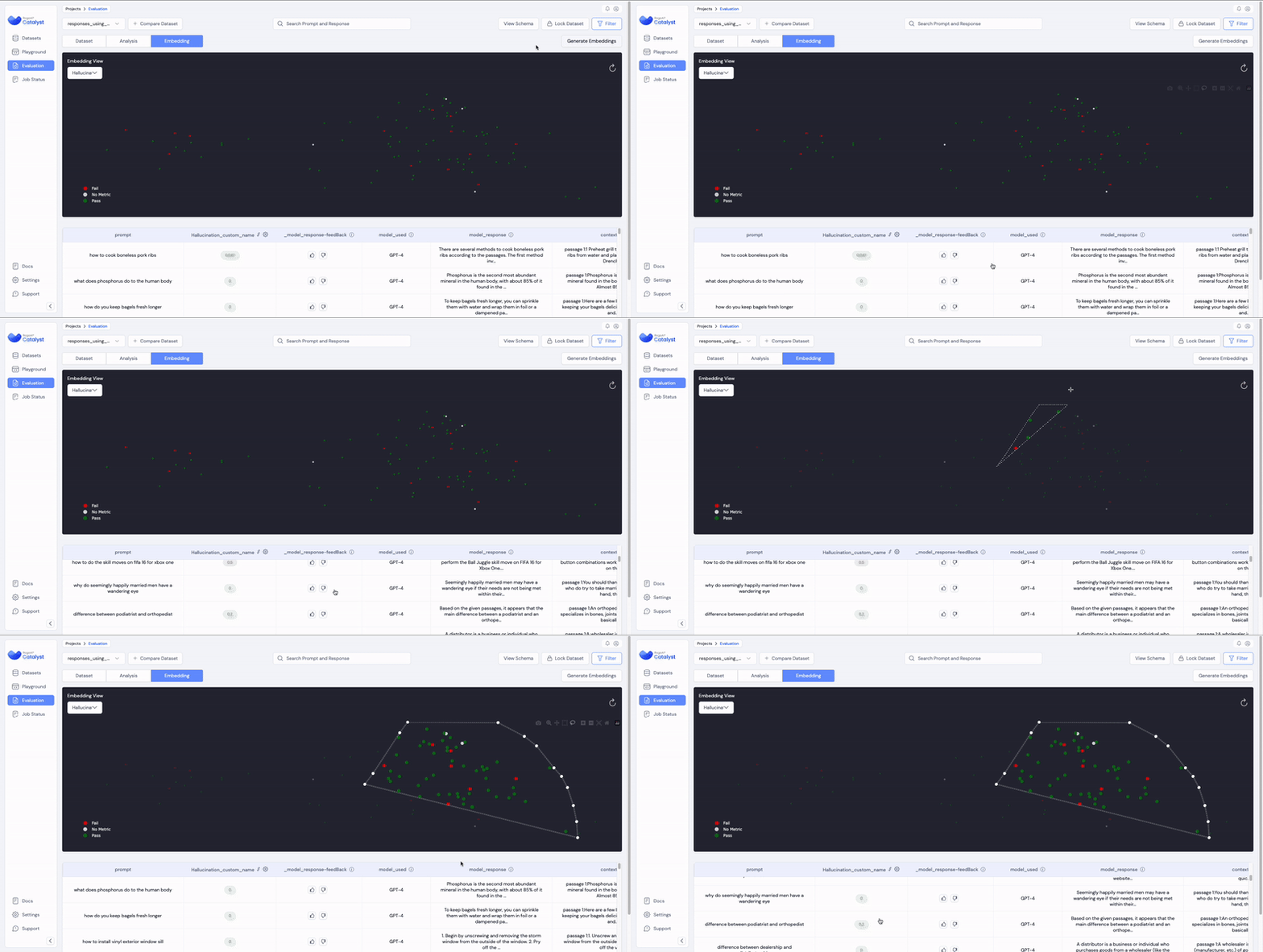
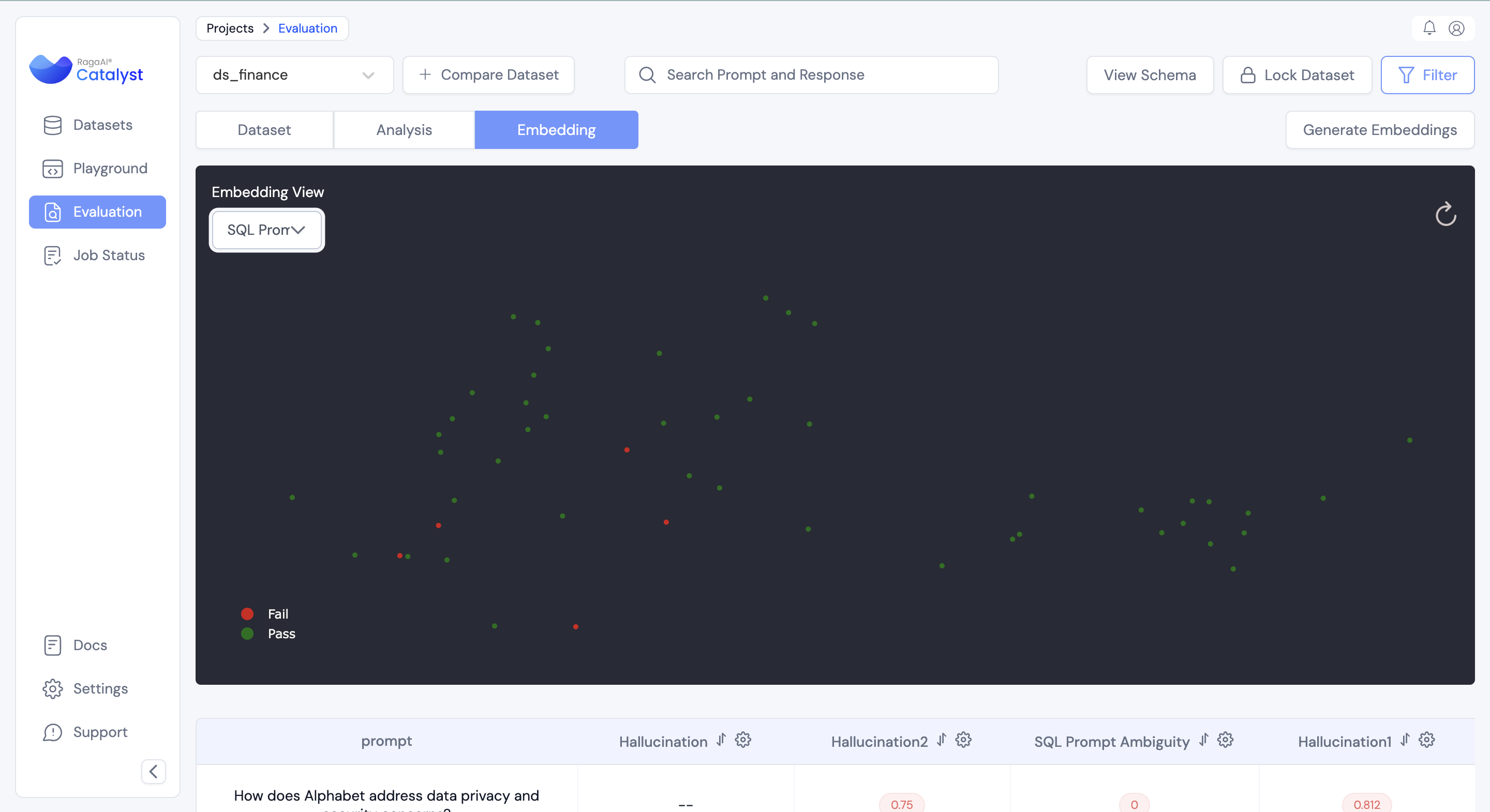
* When the job is complete, you’ll be able to visualise the embeddings directly in the interface.
* **Note**: If the number of generated embeddings exceeds the visualization limit, the platform will automatically sample points to fit within the limit.
#### 5. Color Coding for Insights
* The generated embeddings can be color-coded based on a specific metric, user can toggle using the dropdown.
* The color coding will differentiate between **pass** and **fail** data points, providing a clear visual cue for performance trends within the dataset.
datapoints color coded on the basis of metric
***
### Important Notes
* If you don’t apply any filters, embeddings will be generated for all available data points.
* The platform automatically handles large datasets by sampling data points for visualization purposes if needed.